Sunday, 15 March 2015

Field Training at Mawson Station

Field triiiiiiiiip!


Hellz yeah we travel light.
Every wintering expeditioner at Mawson this year has already, or will soon, undergo a three day field training session with our Field Training Officer JB. We traverse up onto the ice plateau in groups of four in order to gain passing familiarity with the local area and field huts, practice quad bike riding, learn how to navigate with compass and GPS, and gain the other basic skills that are necessary to survive in this inclement environment.

Travel in style.
Station Leader John, Dr. Kate, and Idle-Hands I were in the second group to participate in the training. We left Mawson Station on the 6th of March after a day of extensive preparation and followed JB over the ice all the way to Mt Henderson and the Hendo Hut. 


Hendo is a special place.

Hendo is the closest hut to Mawson. In a pinch you could sleep four people in it (although you would want to be close friends). Getting to Hendo involved traversing the huge expanse of ice that is the plateau, followed by a steep snow hillclimb, a blowing snow plateau, a small rocky pass and finally a sharp right-hander into a steep hillclimb to the hut. Missing the final right hand turn in low vis conditions would result in a very sudden descent back down to the ice plateau, which is part of the reason why JB takes us there during training. It's definitely worth the effort though, my mind was blown by both the environment and the view. Our time at Hendo was short this visit, but you can depend on me going back for a proper look around in the future. 

That's not a road....
After a nervous multi-point turn to get out of the Hendo parking lot and gingerly making our way back down to the main plateau we took off for the Northern Masson Range, stopping via waypoint F-10 (look I have lingo)  to check out a nearby crevasse . Crevasses are a hazard that are common in ice landscapes; cracks in the ice that can be incredibly deep. They range from being millimeters wide to several meters, and have been known to swallow vehicles whole. This crevasse was particularly noteworthy because it is within 100m of a marker on the main route out of station. As with the cliff leading to Hendo hut, it is imperative that we get familiar with these dangers in fine weather so they can be avoided when the visibility drops. 


Laugh in the face of danger. Just don't stand on it.
We continued from F-10 to Rumdoodle Hut at the base of the Northern Massons. 
Chateau Rumdoodle
via Shark's Fin.
It was getting late in the day at this point so we set about securing and refueling the quads, and getting organised for the night. This involved cooking over a camp stove (survival practice), and setting up a bivvy (more survival practice :'D). My post "I Dream of Bivvy" will tell you more than you ever wanted to know about my night in the bivvy... 
Masterchef Mawson
Refueling is a team effort.
Saturday morning we were up early to pack all our equipment away and enjoy a hearty porridge breakfast. Once we were settled hutwise we began the more specific field training, including:
  • navigating using GPS units, compasses, maps
  • radio calls for scheduled check-ins (“skeds”)
  • knots and hitches (bowline, figure-eight on a bight, figure-eight follow-through, double fisherman's, alpine butterfly, tape knot, Italian hitch, clove hitch)
  • 3:1 and 6:1 mechanical advantage rope systems for quad recovery
  • setting ice-screw anchor points
  • setting a quad bivvy,
  • search and rescue in a nil-visibility scenario
  • throw-bag use
  • self-arrest when sliding on ice
"Where's the nearest macca's?!"
Focus too hard on the task at hand and you will miss the beauty all around you.
Solution: delegate.
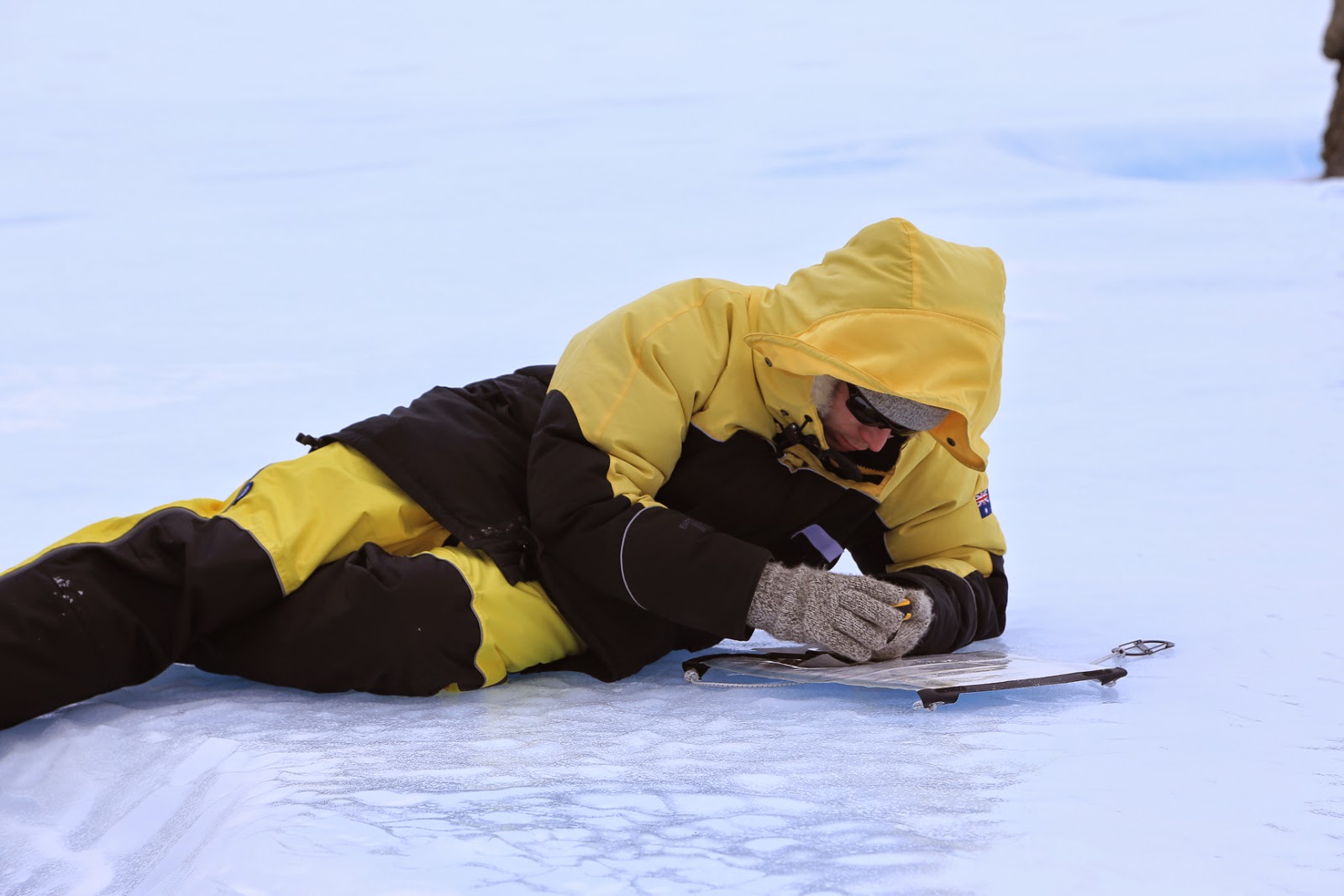
Self arrest in 3.. 2.. 1..
Go!
Strike a pose!
We also went for a short ride to visit the Rumdoodle Ski Landing Area, which is a small ice landing strip for light aircraft. This was an incredible experience for me because the runway is just about as remote as you can get, but it is clearly marked with pole and orange cones on each side, 100m apart for two kilometres. The SLA is a an enormous area of typical human re-organisation that is in the absolute middle of nowhere, in the harshest climate on earth, and only gets used once a year, yet it stands as a permanent fixture. The ice doesn't get before the planes land, and snow can't build up because there is too much wind. Think to yourself: "7000km away, isolated on a vast flat sheet of ice, is a runway that requires no maintenance and never gets used". It makes me wonder what other amazing human constructions are out there that no one ever sees. 
After our full-tilt day we returned to Rumdoodle for Thai green curry (hut-style) and a deep sleep inside the hut. We turn the heating off through the night, but it was still much more comfortable than lying outside. On Sunday we woke to a beautiful day, clear skies and no wind, so we packed up and set out early to Fang Peak. Once we got to Fang we practiced hut procedures again, then made our way to the top of ridge to do a resection exercise and just generally poke around. The view was spectacular.
Heating is the priority.
Then you can take in the view. 


It just keeps going up...
and up.

It is important that we are able to recognize the notable peaks in the area should our GPS fail in the field. This exercise is, of course, a wonderful excuse to admire the view. After looking around for just long enough that the cold and wind became annoying we made our way back down to the hut, ate our lunches, and began the hour-and-a-half slog back to station.
Shower time!
The field training trip was an incredible experience. The plateau is an altogether different environment to our little shore-front station, with ice as far as you can see in every direction. The only colours are white, blue and brown, but they are present in a magnificent and full spectrum of shades. At no point did I feel like I wasn't learning something new, and even though I was aware of the area's unique dangers I felt safe the entire time. Thanks team.


Thanks for reading!
I took more photos on this trip than I could reasonably expect you to look at, but I've still included a fair few below on the off chance you really have nothing to do today :)

Question: There are far more photos in this post than I have ever included before. Please comment if you had a hard time loading them all and think I should reduce the size of the photos for future posts.

 Obligatory animal photos

Camera shy Adelie visited us at a barbecue.
Look at his little foot prints!


The rest

Rumdoodle


Training


From Fang


Tuesday, 10 March 2015

I Dream of Bivvy

A short story discussing the joy that is bivouac bag. 

As a part of our field training we are required to spend a night sleeping out under the stars. Yup, out under the stars…. In Antarctica. And it's just about as much fun as it sounds.

Any time we travel off station we take a survival bag with us; the majority share of which is just sleeping equipment: one or two sleeping bags (depending on personal preference - I'm a two sleeping bags kind of guy), a sleeping bag liner, and a bivouac sack or "bivvy bag". The bags that the AAD provide are a large nylon sack with something akin to a yoga mat rolled up inside it. The theory is that should the expeditioner become isolated during bad weather, they can whip the bivvy off their pack, throw it down and hopefully get both themselves and the rest of their pack inside before the bivvy blows away. Our night out using the bivvy as shelter is to demonstrate that should the excrement really hit the fan, the bivvy will keep you alive.

Unfortunately for us the weather was perfect for our training and we had ample time to set up without the bivvy becoming a sail. I meticulously chose the smoothest, most sheltered, sweetest patch of rocks I could find. I carefully laid out my bag, and piece by piece built a home away from home. Being my first night out in the wild I went all out to avoid being cold: between the ground and my body there was the bivvy bag, bivvy mattress, a bear rug, a spare sleeping bag, my summer sleeping bag, my winter sleeping bag, my winter sleeping bag liner and several layers of clothes. When it was finally time for bed (around 10pm) I carefully arranged my equipment for optimum ease of access should I wake in the night: survival bag as a wind break and to prop the bivvy off my face, boots on my other side to provide more support, gloves and neck warmer on my left, and a snack, pee bottle and head torch to the right. And most importantly, ready access to a set of earplugs and an eye mask. I whipped off my bulky outer layers, struggled into all the sleeping kit (quite a mission, I suggest you try it), and snuggled in to the most comfortable rocks. Comfy and cosy, I settled in to sleep.

WHACK. WHACK THWACK WHACK!

I'll tell you this for nothing: gusting wind against a bivvy bag is a sleep killer. I wasn't worried though; the plastic is away from my face and my trusty ear plugs will keep the super-loud chip packet noise at bay... except I've lost them. Somewhere in three layers of sleeping bags, a survival bag, two big winter boots, and all my other survival stuff, is a tiny packet of misplaced ear plugs.

Oh.

Whack thwack whack.
At this point I knew that sleep simply wasn't going to come without some noise damping. I start tearing down my kit, struggling, twisting and turning, with the bloody bivvy plastic resting on my face and three sleeping bags constricting me, and my big bloody winter boots everywhere, and rocks moving and the cold bloody wind gusting in. Nope. It's dark, it's confined, I can't move and I can't make space. Not going to find them. Better to just give up and try to sleep.

Thwack whack whack.

Thirty minutes later I've reached breaking point again and I'm searching, twisting, cursing. Becoming more and more uncomfortable and frustrated. But there are only so many places to look inside a bivvy bag, and only so many positions you can twist into. Time passes and I yield again, give in to my body's demand for rest, settle in to a somewhat less comfortable nest than I had first constructed.

Thwack. Again. Half an hour of fruitless sheep counting and I'm broken. The search begins anew, and again there is no reward for my efforts. I decide to break free from this unforgiving cycle and try something different. I move my pack to above my head to try and stretch the bivvy out, move my boots and wedge them in place holding the bivvy high. I tighten the bivvy exit to reduce surface area. I hide my head under all the sleeping bags, and burrow, one ear pressed to the rocks beneath and the other stuffed full of sleeping bag. Finally I'm curled in foetal position, body roasting, awkwardly perched on rocks that I have shifted in my frenzy. My careful planning is a distant, mocking memory. In one last ditch attempt for some blessed silence I grasp the bivvy in my bare hands and twist, hold it close to my face, create enough tension that it can no longer THWACK in my face.

Sweet stillness prevails.

I can tell you one thing with certainty: sleeping while clutching a fistful of taut, -20 degree C plastic to your face is non-starter. Sure, sleep might come. I think I did actually drift off once at this point. And the moment I did… I released the bivvy.

... thwack ...

It's now 12:30am and I can hear one of my companions snoring, oblivious to the turmoil in my mind.Two and a half hours of pure stress and frustration have passed. I reach for my head torch and start to dissemble my once-palace, determined to find the cursed earplugs or die trying. And lo- there, under my survival bag, in a place I've searched four times already, lie the ear plugs. Frozen solid.

Finally a problem I can solve. Full with the light of hope once again, my heart singing, I place the packet against my skin to warm. Minutes later the earplugs go in, and I find my well earned rest.